
St. Clair County Traffic Court Records
Traffic in St. Clair County belongs to one court. Civil infractions and misdemeanors both go through the 72nd District Court. That court operates from Port Huron and Marine City. The location printed on your ticket decides where a payment or a question belongs. A traffic case history can include the citation and a responsibility or plea event. It may also list hearings, the public disposition, fine and cost entries, an abstract, and payment status where public. It is a court file, not just a receipt.
Public searching starts with MiCOURT Case Search, using the Criminal/Traffic/Civil Infractions category. The county payment route is a separate tool. Paying through it resolves an eligible fine. But it never replaces a docket search, clerk confirmation, or a court-record request. A new citation can also take a little time to reach either public layer.
St. Clair County Traffic Court Locations
The bottom of the citation names your 72nd District Court location. Port Huron traffic and criminal matters are handled in Room 2900 at 201 McMorran Boulevard. The traffic and criminal line there is 810-985-2072. The Marine City branch sits at 2088 South Parker Street. Its clerk line is 810-765-4057. Both addresses belong to one district court. They are branches, not separate city courts.
Confirm the printed location before paying online, mailing a payment, or calling about a court date. The county warns that the wrong court can leave a citation unresolved. Tickets are not always clear. If yours is confusing, call either branch with the citation number and ask which clerk holds the case. That beats guessing from the road or city.
Note: The court location on a public case history is a key field when a ticket must be matched to the right District Court clerk.
Looking Up a Traffic Ticket
Use the citation number when you can. MiCOURT lets you search by name or case number. The county's online payment instructions lead to a payment processor instead, one built for an eligible court payment. Read both the court location and the response date. Remember that a payment processor is not a public document archive, and its exact live field labels can vary.
- Read the citation for its ticket or case identifier, court location, and appearance or response date.
- Search MiCOURT by case number or by the name printed on the citation, using the Criminal/Traffic/Civil Infractions category if needed.
- Use the county payment route only after confirming the correct Port Huron or Marine City location shown on the ticket.
- Call Port Huron at 810-985-2072 or Marine City at 810-765-4057 if the citation has not posted, the balance is unclear, or a date needs confirmation.
- For in-person review, ask the District Court Clerk about public file access; the public district terminal is identified for public misdemeanor files, and the traffic clerk can explain civil-infraction access.
Mail payments count when received on or before the hearing date, per the official fine-schedule instructions. Confirm the mailing address and current method first. The ticket or the clerk is the reliable source, since the instructions give no universal address for every citation.
St. Clair County Traffic Ticket Fields
The county payment page and MiCOURT ask for different fields. The payment route wants the ticket or case identifier. It also wants your name as printed, the court location, and payment details. MiCOURT's public search works differently. A last name or business name is required, with a two-character minimum. Optional pieces include first and middle names and a four-digit birth year. Status and category filters, plus filed or offense-date ranges, are optional too. The processor's own field list is not fixed. The ticket remains the best source for its identifier.
| Tool or field | Type | St. Clair use |
|---|---|---|
| Ticket, citation, or case identifier | Text | Use the number printed on the citation for court search or payment routing. |
| Court location | Selection or display | Confirm Port Huron or Marine City before any payment action. |
| Last Name or Business | MiCOURT text field | Required for public name search; use at least two characters. |
| Case Status and Category | MiCOURT filters | Active or Closed, plus Criminal/Traffic/Civil Infractions where useful. |
| Filed or Offense Date | MiCOURT date range | Optional filter using a displayed MM/DD/YYYY style. |
The county's online payment information covers 24-hour card access, the accepted card brands, an enhanced access fee, and the need to choose the correct court. Read it before you pay.
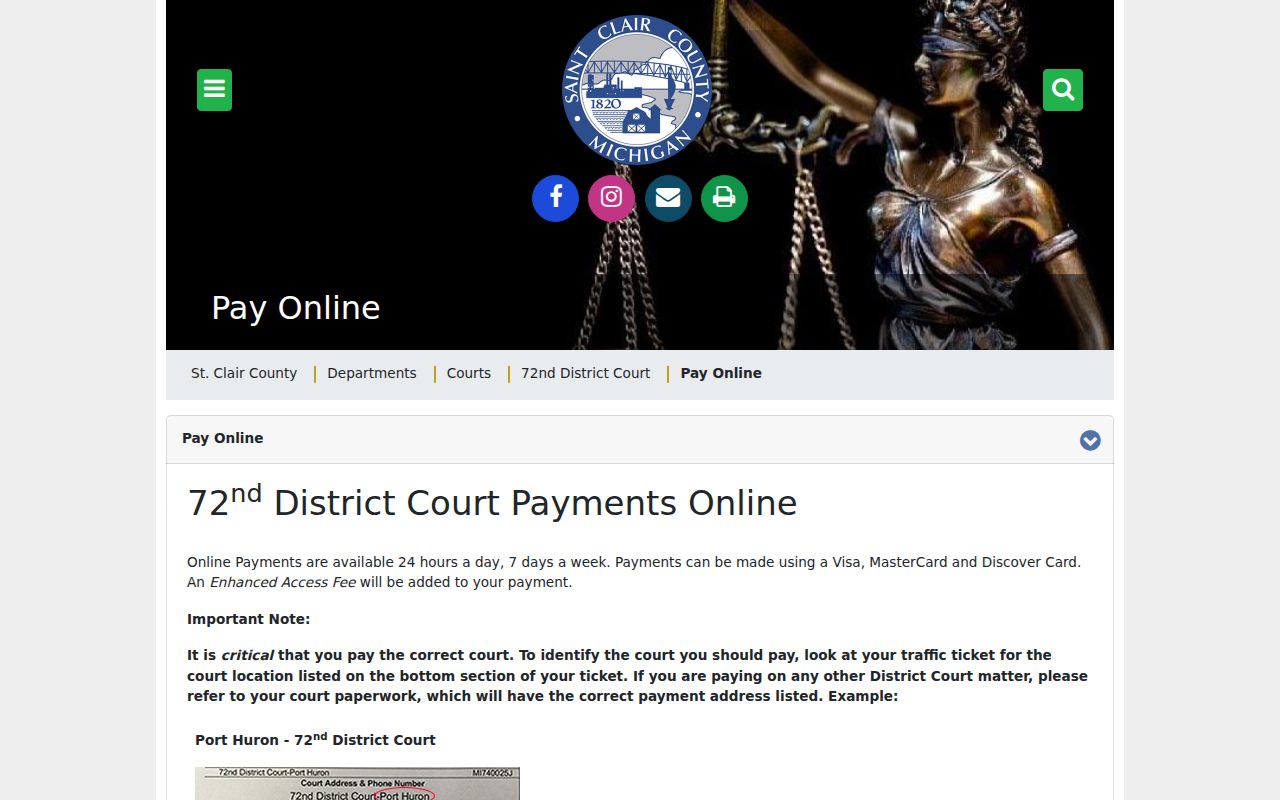
The payment route helps once you know your court. Just remember its access fee is separate from the court fine or cost shown in the case record.
How to Find Your Traffic Court Date
Your ticket holds the first response or hearing information. Later settings appear in the public case history. Check the citation and the docket together, since one may be newer than the other. St. Clair Web Inquiry serves calendar-focused searches. It uses a hearing-date range and may require a hearing location or hearing officer for a span longer than seven days and no more than 31 days. The public calendar result links back to the case history.
| Citation or case number | The ticket identifier or a court case number used to locate a record, such as the local pattern 00-000000-XX where applicable. |
|---|---|
| Court location | Port Huron or Marine City, as printed on the ticket and shown in the case history. |
| Date and time | The initial citation response date or later public hearing setting. |
| Hearing information | The public description of the event, read with the date, time, court location, and officer when shown. |
| Status | A public case-management entry that should be checked with the latest dated event. |
For a setting that matters soon, ask the clerk. An older online date is not the final confirmation, since a reset, continuance, notice, or hearing-held entry can change the next action.
St. Clair County Traffic Docket Dates
Three St. Clair court layers can show a traffic date. They are the case-history Register of Actions, the Web Inquiry calendar search, and the MiCOURT Court Display. Court Display follows a date-oriented pattern. It lists party name, time, hearing information, case number, and CTN. One caution applies to its links. A display link can require JavaScript or turn stale. So treat it as no permanent record of every court date.
Old settings can linger. A past case-history setting may stay visible after the matter moves. So look for a later reset, continuance, notice, order, or hearing-held entry. Calendars and name searches can disagree. Use the case number then. If the calendar lists the case but a name search does not, call the correct District Court branch. The St. Clair County court dates reference has more detail on those calendar channels.
Pay or Contest a Ticket
Paying a St. Clair County traffic ticket means admitting responsibility for it. That admission also gives up the hearing. The county's civil-infractions information makes both points plain. Anyone who disputes the citation or wants to be heard in court should follow the court's instructions. Do that before sending any money. Your response deadline comes from the ticket itself. The official fine schedule says its payment options apply when payment arrives on or before the hearing date. Take a case to court, though. The amount owed or the outcome can differ from that schedule.
| Paying an eligible ticket | Contesting a ticket |
|---|---|
| The county says payment admits responsibility and waives the hearing. | Follow the court's instructions for a hearing or other response before making payment. |
| Use the correct Port Huron or Marine City location and confirm the cited amount. | Keep the citation and case number available when contacting the District Court Clerk. |
| Payment may be made online, in person, or by mail when the court's current instructions allow it. | The public docket and clerk can confirm the next court event after a response is received. |
Do not infer a past-due amount: The county directs people with past-due or suspended FAC/FCJ citations and probation matters to call for the exact amount. Failure to appear or failure to comply can trigger state licensing consequences, so contact the court that holds the citation rather than relying on an old online balance.
The 72nd District civil-infractions page is the official source for the responsibility-and-hearing distinction.
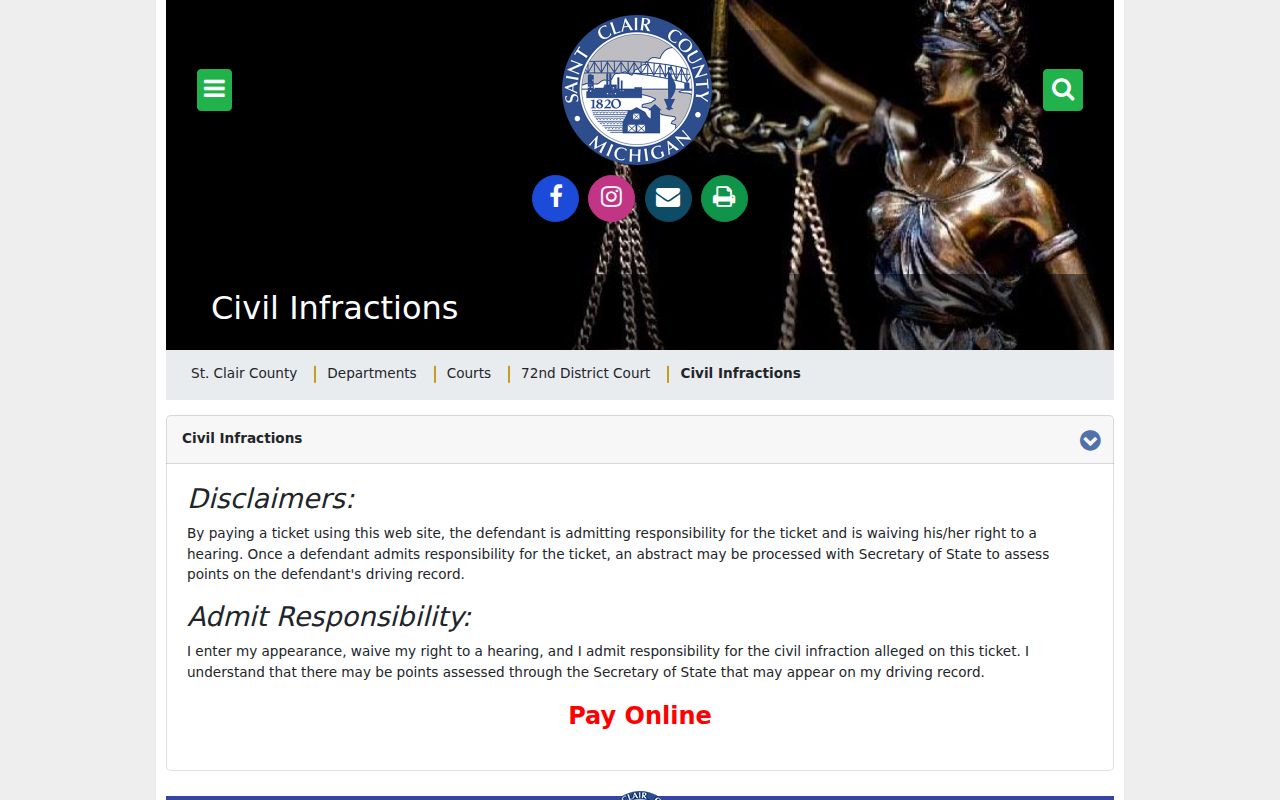
That payment rule covers only the court response. It does not govern every later filing or status question in a traffic case file.
St. Clair County Traffic Fine Schedule
Sample amounts, not a guaranteed quote. That is what the official 72nd District fine-schedule PDF offers. Speeding runs from $85 at 1 to 5 over the limit. It climbs to $250 at 26 to 30 over. Disobeying a stop sign is listed at $100. Defective equipment is $90, and the schedule includes other entries as well. One caution appears inside the document itself. It does not apply to cases heard in court. The clerk can confirm the current figure before you pay.
| Fine-schedule example | Published amount | Important limit |
|---|---|---|
| Speeding 1 to 5 over | $85 | Example from the PDF; verify current amount. |
| Speeding 11 to 15 over | $125 | Cases heard in court can differ. |
| Careless driving | $135 | Published schedule entry, not a case-specific quote. |
| Defective equipment | $90 | The PDF describes a repair and police-signoff condition within ten days for waiver of this amount. |
For your true citation total, trust the ticket and the clerk, not the PDF's sample figures.
Traffic Court Record vs Driving Record
A traffic ticket creates two separate records. Two different offices keep them. The 72nd District Court docket is the court's own case history, covering the citation and every court event tied to it. The Michigan Secretary of State keeps a driving record apart from all that. A docket search of the court can show the docketed citation, a responsibility or plea event, hearings, the disposition, fine or cost entries, abstracts, and public payment or status details. The driving record is something else entirely. You request it through the Secretary of State's own official process.
| Question | Court traffic record | Michigan driving record |
|---|---|---|
| Custodian | 72nd District Court Clerk in the ticket's Port Huron or Marine City location. | Michigan Secretary of State. |
| Purpose | Case history and documents for the court citation, hearing, disposition, and court financial entries. | A separate state-maintained licensing record. |
| Request route | MiCOURT for public history, then the District Clerk for a court record or copy. | The Secretary of State's official driving-record request process. |
The Michigan Secretary of State driving-record page lays out that agency's separate request routes and pricing options.
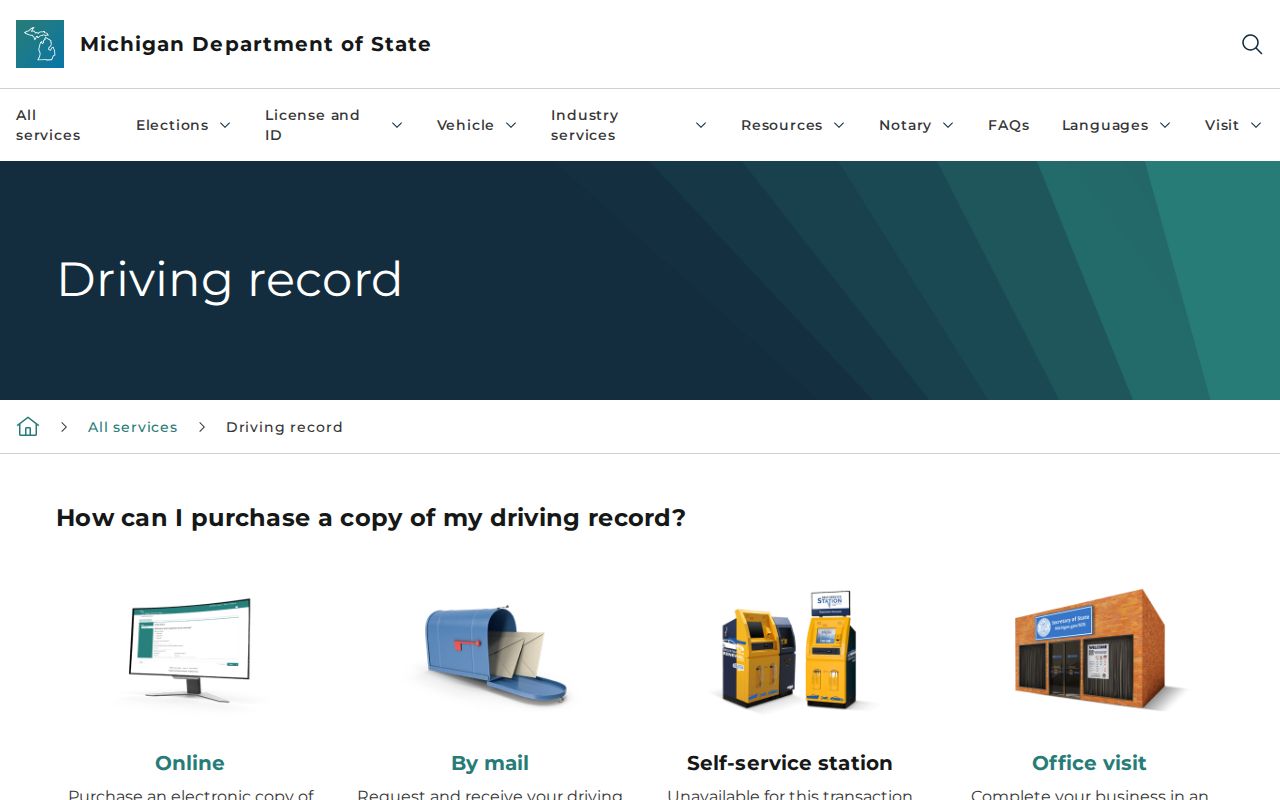
This split between offices matters when something is wrong. The court clerk must fix the court matter first. Only then can a corrected abstract move through the state's stated process.
St. Clair County Traffic Court Abstracts
An abstract is a summary of a traffic case outcome. The court sends it to another agency. The St. Clair civil-infractions page notes an abstract may be processed with the Secretary of State. That can happen after a ticket is paid. What if the abstract is wrong? The Secretary of State tells a person to contact the court for the correction. Then submit the corrected abstract to the Driver Record Activity Unit at 7064 Crowner Drive, Lansing, MI 48918, or by fax at 517-636-7525.
Course records sit outside the 72nd District Court case file. The Michigan Secretary of State course reference notes that court fines and costs remain the court's responsibility.
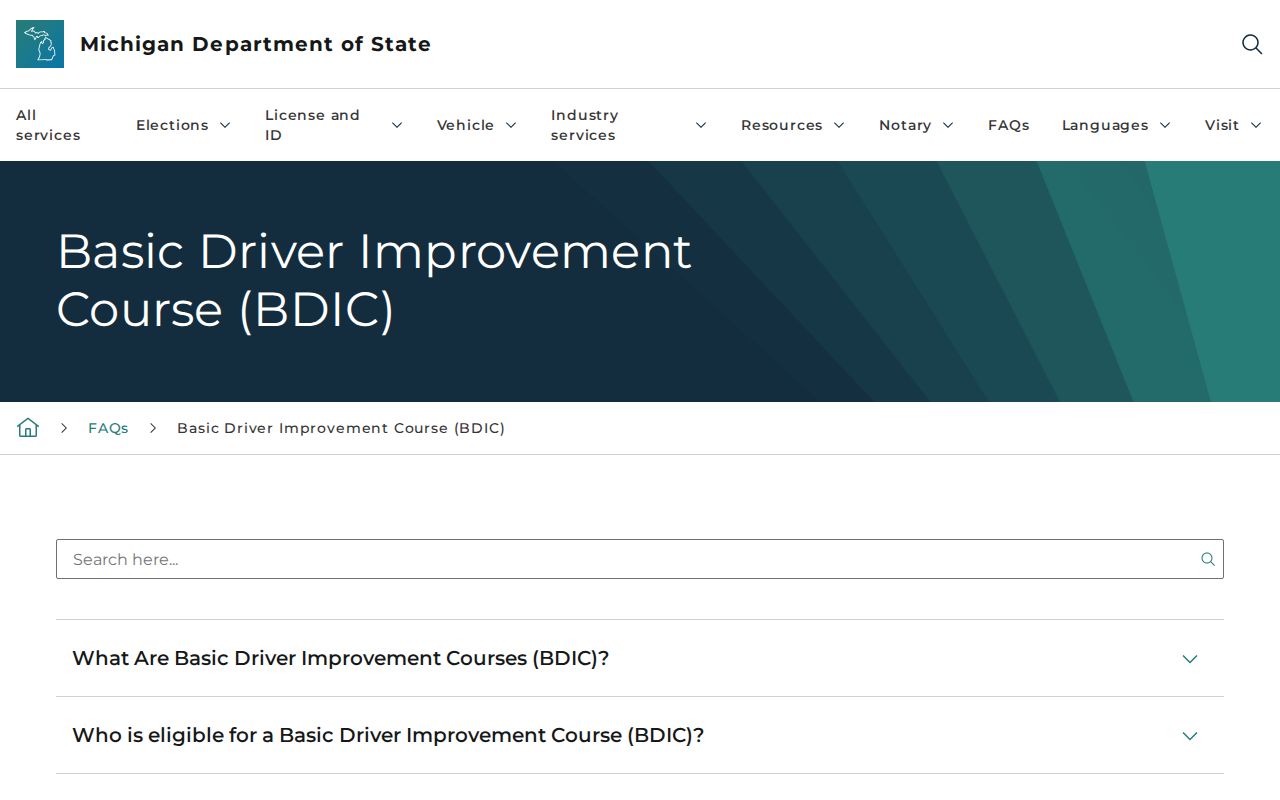
That line keeps things clean. The court docket stays focused on the citation and its court result, while the state agency holds its own administrative materials.
Copies and Fees
Three charges get confused for one. A traffic fine, a payment-processor access fee, and a court-record copy charge are all different amounts. The payment page states that an enhanced access fee is added to online card transactions. It gives no single universal dollar figure. For a public or certified District Court record, ask the District Court Clerk which copy procedure fits the traffic file. Ask also whether a public redacted version exists. One more caution: the County Clerk's circuit document form is not a traffic-record request form.
| Item | Published fee or route | Notes |
|---|---|---|
| Online card payment | Enhanced access fee added | The county payment page does not state one universal dollar amount. |
| Certified District Court copy | $10 plus $1 per page | Listed on the county District Court fee materials; confirm current traffic-copy procedure. |
| Traffic case history | Public MiCOURT display | Informational court history, not a certified document image. |
Ask before you pay. A certified court record, a docket printout, and a document image do not share the same access route.
St. Clair County Traffic FAC FCJ
FAC means failure to appear. FCJ means failure to comply with judgment. On St. Clair traffic pages, the second code applies to past-due or suspended matters. The District Court tells callers to get the exact amount owed. That covers those citations and probation matters. A public balance can be incomplete or outdated. Never treat it as the final amount needed to resolve a court obligation. The Michigan Secretary of State restoration information lists failure to pay a ticket or court fee, along with failure to appear, as possible state licensing consequence routes.
The first local step is a phone call. Contact the Port Huron or Marine City District Court Clerk with your citation number and ask for the current court status and the response it requires.